Welcome: Chongqing Chuanyi,Siemens,E+H,Yokogawa,Rosemount-Bobo Fluid Control Equipment (Wuhan) Co., Ltd.


info@baoboindustry.com 18827058766
The Yokogawa S&T differential pressure transmitter is designed to prevent the medium in the pipeline from directly entering the transmitter. The pressure-sensing diaphragm is connected to the transmitter via a capillary tube filled with fluid. The differential pressure transmitter is an open-loop instrument without a complete negative feedback loop. Adjusting the zero point and performing zero shift have no impact on the measurement range, but adjusting the measurement range will affect the zero point. Without zero shift, the impact is minimal. The following describes the general calibration methods and steps. Therefore, the calibration of capacitive differential pressure transmitters is based on an open-loop structure.
Divide the measured differential pressure range into four equal parts, and input the corresponding differential pressure values at each point as 0%, 25%, 50%, 75%, *. Then, the transmitter outputs currents of 4, 8, 12, 16, 20 mA, and its error should be less than the basic allowable error. If there is a discrepancy, readjust the above-mentioned items, and perform linear adjustment if necessary. Connect the wires according to the calibration circuit diagram, and power on after checking that there are no errors.
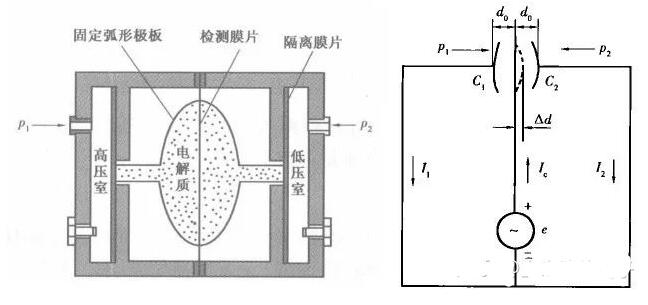
The main function of the Yokogawa S&T EJA110E differential pressure transmitter is to measure pressure. A common and useful industrial pressure measurement instrument is the differential pressure transmitter. This device detects the pressure difference between two ports and generates an output signal based on a calibrated pressure range. Industrial differential pressure transmitters consist of two housings. The pressure sensing element is installed in the lower half, and the electronic components are installed in the upper half. It will have two pressure ports labeled "high" and "low". The high port is always in a high pressure state, and the low port is always in a low pressure state, which is not mandatory. This labeling is related to the impact of the ports on the output signal.
(a) Direct pressure sensing element (located inside the lower housing).
(b) Electronic unit: The electrical signal generated by the sensor in the lower chamber is only within the millivolt range.
2. Industrial application of differential pressure transmitter:
(b) Water and wastewater treatment plants. It is primarily used for monitoring the filters in these plants.
(d) Remote sensing for heating systems using steam or hot water.
(f) Pump control and monitoring.
Contact: Mr. Li
Phone: 18827058766
Whatsapp: +86 18827058766
Email: info@baoboindustry.com
Add: 503-4, No.03, Floor 5, Building 2, International Enterprise Center, No.1 Guanshaner Road, Wuhan East Lake New Technology Development Zone
We chat